

I have lived through both sides of this equation.
In my 20s, my life was almost entirely focused on creation.
I built my first company.
I built friendships.
I built experiences.
I consumed very little.
I rarely watched television. Maybe a movie here or there. Social media barely existed yet. Most of my time and energy went into building something.
In hindsight, I probably pushed it too far. I didn’t always take great care of my health. My diet consisted largely of McDonald’s and Dunkin’ Donuts.
But I was creating constantly.
And I was deeply fulfilled.
There have been other periods in my life that looked very different.
Last February, when I stepped down as CEO of Restore, my life shifted more toward consumption.
Don’t get me wrong, there were plenty of great experiences. I traveled. I spent time with friends and family. I built some wonderful memories.
But if I’m honest, I also consumed more than I created.
More media.
More toys.
More properties.
At one point I bought a quad-350 horsepower fishing boat that cruises at 50 mph. It’s an incredible machine. It also consumes fuel at an outrageous rate. It ended up being a pretty good metaphor for that phase of life.
I’ve also watched many friends go through a similar transition.
Once they achieve financial freedom, their lives often shift toward pleasure optimization.
And pleasure optimization almost always translates into more consumption.
More travel.
More toys.
More luxury goods.
More media.
What I’ve observed, both in my own life and in the lives of others, is something surprisingly consistent.
The more a life becomes centered on consumption, the less satisfied people tend to be.
The reason, I think, is simple.
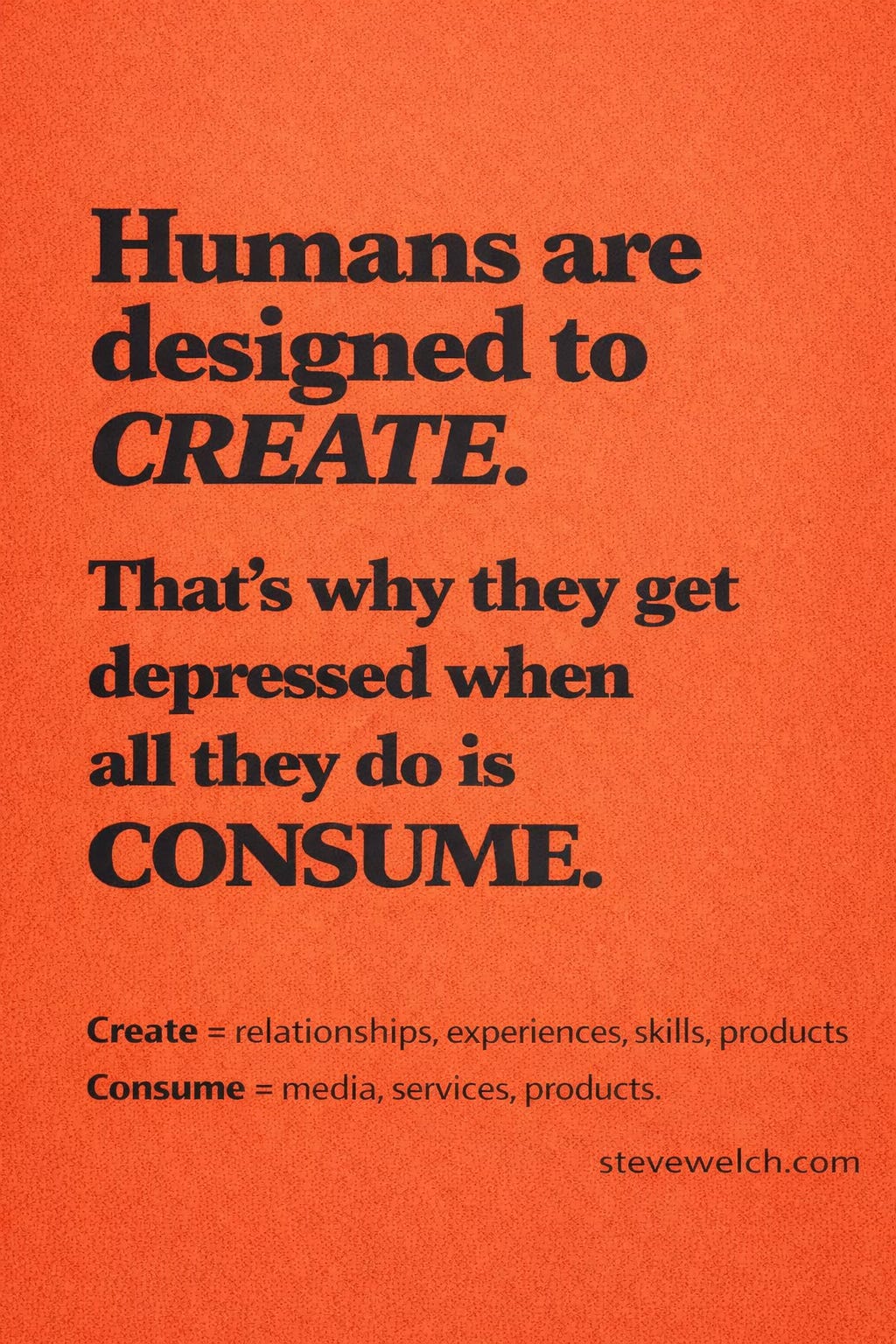
Humans are designed to create.
We are happiest when we are building something:
Relationships
Experiences
Skills
Products
Ideas
Creation gives life momentum. It produces progress. It produces meaning.
Consumption, by contrast, is passive. It may feel good in the moment, but it rarely produces lasting satisfaction.
This is especially true of modern forms of consumption like media and social media, which are engineered to capture attention without requiring much effort in return.
But this dynamic extends far beyond wealthy adults optimizing their lives around consumption. The deeper and more concerning shift is happening among young people.
For most of human history, children had very limited opportunities to consume. Entertainment was scarce. If kids wanted stimulation or connection, they usually had to create it themselves.
They built forts.
They invented games.
They explored neighborhoods.
They developed skills.
They formed friendships through shared activity.
Childhood was naturally oriented toward creation.
But over the past fifteen years something has changed dramatically.
For the first time in history, children have access to unlimited digital consumption. Social media feeds, streaming platforms, and immersive games can absorb hours of attention with almost no effort required from the user.
This shift fundamentally changes how young people spend their time.
Activities that once required creativity, effort, and social interaction are increasingly replaced by passive digital consumption.
At the same time, we have seen a sharp rise in anxiety and depression among adolescents.
Mental health is complex, and social media is certainly not the only cause. But the timing is difficult to ignore.
A stage of life that was historically dominated by skill building, exploration, and relationship formation is increasingly shaped by passive consumption.
Less creating.
More consuming.
And if humans truly are wired for creation, the psychological consequences of that shift should not surprise us.
When I stepped back into building companies again, something interesting happened.
The act of creation didn’t just affect my work.
It changed the orientation of my entire life.
When you are building something meaningful, everything else begins to organize itself around that process. Your relationships deepen. Your time becomes more intentional. Even your leisure becomes more purposeful.
Creation becomes an anchor.
Consumption will always be part of life. There is nothing wrong with enjoying the fruits of success.
But a life dominated by consumption almost always drifts toward dissatisfaction.
A life anchored in creation tends to move in the opposite direction.
Because at a very deep level, humans are not designed to watch the world.
We are designed to build it.
I feel like I'm doing a pretty good job of promoting creation for a 7-year-old, but if you have any insights for the upcoming teen years, I'm all ears!